January 25, 2022
The writings of Paul and the Apostles have clearly identified that any Christian doctrine or teaching must be consistent with the Old Testament scriptures or it is not “…profitable for doctrine, for reproof, for correction, for instruction in righteousness. . . ” (2 Timothy 3:16)
Since the Apostles used this methodology, so must the modern church. The only way to restore accurate scriptural imagery, patterns, and fractals is to use the scriptural terminology and contextual meaning provided from the scriptures themselves, without our own man–made terminology and definitions. Once we follow this methodology we will see more and more mysteries plainly and simply revealed, and many of the modern churches delusions scripturally cast down. Much like the parable of the talents, those who are “faithful” will gather more talents.
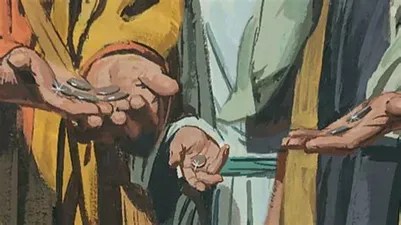
Matthew 25: 14, For the kingdom of heaven is as a man travelling into a far country, who called his own servants, and delivered unto them his goods. 15 And unto one he gave five talents, to another two, and to another one; to every man according to his several ability; and straightway took his journey. 16 Then he that had received the five talents went and traded with the same, and made them other five talents. 17 And likewise he that had received two, he also gained other two. 18 But he that had received one went and digged in the earth, and hid his Lord’s money. 19 After a long time the Lord of those servants cometh, and reckoneth with them. 20 And so he that had received five talents came and brought other five talents, saying, Lord, thou deliveredst unto me five talents: behold, I have gained beside them five talents more. 21 His Lord said unto him, Well done, thou good and faithful servant: thou hast been faithful over a few things, I will make thee ruler over many things: enter thou into the joy of thy Lord. 22 He also that had received two talents came and said, Lord, thou deliveredst unto me two talents: behold, I have gained two other talents beside them. 23 His Lord said unto him, Well done, good and faithful servant; thou hast been faithful over a few things, I will make thee ruler over many things: enter thou into the joy of thy Lord. 24 Then he which had received the one talent came and said, Lord, I knew thee that thou art an hard man, reaping where thou hast not sown, and gathering where thou hast not strawed: 25 And I was afraid, and went and hid thy talent in the earth: lo, there thou hast that is thine. 26 His Lord answered and said unto him, Thou wicked and slothful servant, thou knewest that I reap where I sowed not, and gather where I have not strawed: 27 Thou oughtest therefore to have put my money to the exchangers, and then at my coming I should have received mine own with usury. 28 Take therefore the talent from him, and give it unto him which hath ten talents. 29 For unto every one that hath shall be given, and he shall have abundance: but from him that hath not shall be taken away even that which he hath. 30 And cast ye the unprofitable servant into outer darkness: there shall be weeping and gnashing of teeth.
Now on the surface this parable of the talents makes the Messiah look like a very harsh man and certainly not generous. He is expecting the servant to work. It would also appear to be capricious to hand over the unprofitable servant’s talent to the one who gained 10 talents. Why not give them to the one who gained two talents? Wouldn’t this be more generous to give a talent to one who had less than the others?
Let’s think about the parable of the talents in another way. Every place you see the word “talent”, replace it with the word “truth”. Once you do this you get to the root of what our purpose is here on earth and how it is God’s natural order to give more truth to the one who seeks out and finds the most truth. Take note of how the “unprofitable servant” is associated with being cast into “outer darkness”.
John 3: 18, He that believeth on him is not condemned: but he that believeth not is condemned already, because he hath not believed in the name of the only begotten Son of God. 19 And this is the condemnation, that light is come into the world, and men loved darkness rather than light, because their deeds were evil. 20 For every one that doeth evil hateth the light, neither cometh to the light, lest his deeds should be reproved.
Those who are unprofitable are associated with darkness and rejection of light. By association this is the rejection of the Messiah for He is identified by light and truth!
· John 18: 2, Then spake Yeshua again unto them, saying, I am the light of the world: he that followeth me shall not walk in darkness, but shall have the light of life.
· John 14: 6, Yeshua saith unto him, I am the way, the truth, and the life: no man cometh unto the Father, but by me.
So where can we find the revealing of His light and truth? The same place the Apostles went to validate accurate apostolic teaching, the Written Torah and the Tanach (Torah (Teaching), Nevi’im (Prophets), and Ketuvim (Writings) otherwise known as the Old Testament). Who was the giver of these inspirational teachings?
1 Corinthians 10: 1, Moreover, brethren, I would not that ye should be ignorant, how that all our fathers were under the cloud, and all passed through the sea; 2 And were all baptized unto Moses in the cloud and in the sea; 3 And did all eat the same spiritual meat; 4 And did all drink the same spiritual drink: for they drank of that spiritual rock that followed them: and that rock was Christ. 5 But with many of them God was not well pleased: for they were overthrown in the wilderness.
The Apostle Paul clarifies that it was the Messiah Yeshua who was leading Israel through the wilderness and manifesting the presence of God through His giving of the Law of Moses, the spiritual meat, which Paul is referring to.
John 14: 15, If ye love me, keep my commandments. 16 And I will pray the Father, and he shall give you another Comforter, that he may abide with you for ever; 17 Even the Spirit of truth; whom the world cannot receive, because it seeth him not, neither knoweth him: but ye know him; for he dwelleth with you, and shall be in you. 18 I will not leave you comfortless: I will come to you. 19 Yet a little while, and the world seeth me no more; but ye see me: because I live, ye shall live also. 20 At that day ye shall know that I am in my Father, and ye in me, and I in you. 21 He that hath my commandments, and keepeth them, he it is that loveth me: and he that loveth me shall be loved of my Father, and I will love him, and will manifest myself to him. 22 Judas saith unto him, not Iscariot, Lord, how is it that thou wilt manifest thyself unto us, and not unto the world? 23 Yeshua answered and said unto him, If a man love me, he will keep my words: and my Father will love him, and we will come unto him, and make our abode with him. 24 He that loveth me not keepeth not my sayings: and the word which ye hear is not mine, but the Father’s which sent me.
The writer of Hebrews takes the time to chastise followers of Yeshua that they are not more mature, failing to advance into the more meaningful things (meat) of Christ and instead still being consumed by simple things (milk).
Hebrews 5: 11, Of whom we have many things to say, and hard to be uttered, seeing ye are dull of hearing. 12 For when for the time ye ought to be teachers, ye have need that one teach you again which be the first principles of the oracles of God; and are become such as have need of milk, and not of strong meat. 13 For every one that useth milk is unskilful in the word of righteousness: for he is a babe. 14 But strong meat belongeth to them that are of full age, even those who by reason of use have their senses exercised to discern both good and evil.
We see that their ability to hear is associated with what they are capable of eating. He is clear in saying that by now they should have moved from milk to meat. From Paul’s early comments we can see that this “meat” is associated with the “spiritual meat” of 1 Corinthians 10:3 that was provided by Christ to Israel in the Wilderness, the Law of Moses.
If “law versus grace” is true then we need to understand why the Pre–incarnate Christ is feeding Israel the “Law of Moses”. As we progress you will see that these associations are not accidental and tell us much more than what we might glean from a casual review of the scriptures. We need to be focused, searching, and having a state of mind of “open ears” as opposed to ears that “are dull of hearing”. (Matthew 11:15)
In order to restore accurate doctrinal paradigms, imagery, meaning, patterns, and fractals we need to use the same source the Apostles did. We will be able to validate the truth of these concepts by following the scriptural patterns. These same patterns repeat themselves over and over again in the scriptures, in nature, and in the lives of those recorded in the scriptures. We will be able to check our math, just the same as if you were literally checking your arithmetic by working the equation backwards. If the pattern and the fractal does not hold up when checked from every angle, then it is likely not a scripturally supported belief and needs to be removed.
Knowing that we must depend upon scriptural context we will use extensive and copious amounts of scriptures to establish the scriptural patterns. If you are not prepared for an intensive analysis of scriptural review, you likely will not have the attention span to discover the mysteries that are hidden only for certain people. It requires the diligence of the believer to move from milk to meat.
Matthew 13: 10, And the disciples came, and said unto him, Why speakest thou unto them in parables? 11 He answered and said unto them, Because it is given unto you to know the mysteries of the kingdom of heaven, but to them it is not given. 12 For whosoever hath, to him shall be given, and he shall have more abundance: but whosoever hath not, from him shall be taken away even that he hath. 13 Therefore speak I to them in parables: because they seeing see not; and hearing they hear not, neither do they understand. 14 And in them is fulfilled the prophecy of Esaias, which saith, By hearing ye shall hear, and shall not understand; and seeing ye shall see, and shall not perceive: 15 For this people’s heart is waxed gross, and their ears are dull of hearing, and their eyes they have closed; lest at any time they should see with their eyes and hear with their ears, and should understand with their heart, and should be converted, and I should heal them. 16 But blessed are your eyes, for they see: and your ears, for they hear. 17 For verily I say unto you, That many prophets and righteous men have desired to see those things which ye see, and have not seen them; and to hear those things which ye hear, and have not heard them.
Did you see how Matthew 13 reinforced the conclusion that we drew about the parable of the talents from Matthew 25? Yeshua uses the same phraseology linking the parable of the talents to His explanation of who the mysteries of the Kingdom are given to and why He insisted on talking in parables.
Matthew 25: 28, Take therefore the talent from him, and give it unto him which hath ten talents. 29 For unto every one that hath shall be given, and he shall have abundance: but from him that hath not shall be taken away even that which he hath.
Now compare it to Yeshua’s explanation of why He spoke in parables from Matthew 13.
Matthew 13: 12, For whosoever hath, to him shall be given, and he shall have more abundance: but whosoever hath not, from him shall be taken away even that he hath.
Notice how they use the same phraseology and are almost word for word the same? Are you beginning to understand that there are no careless scriptures and that there is willful intention and patterns in what is written? So when you match up the parable of the talents with Yeshua’s explanation of why He speaks in parables you can clearly see that a “talent” is a “hidden truth”!


Leave a comment